


$1,295,000
Active
5
Beds
6
Baths
7673
Sqft
1.17
Acres
215 Hiland Acres Cir, Pottsboro, TX 75076
MLS#: 21067939



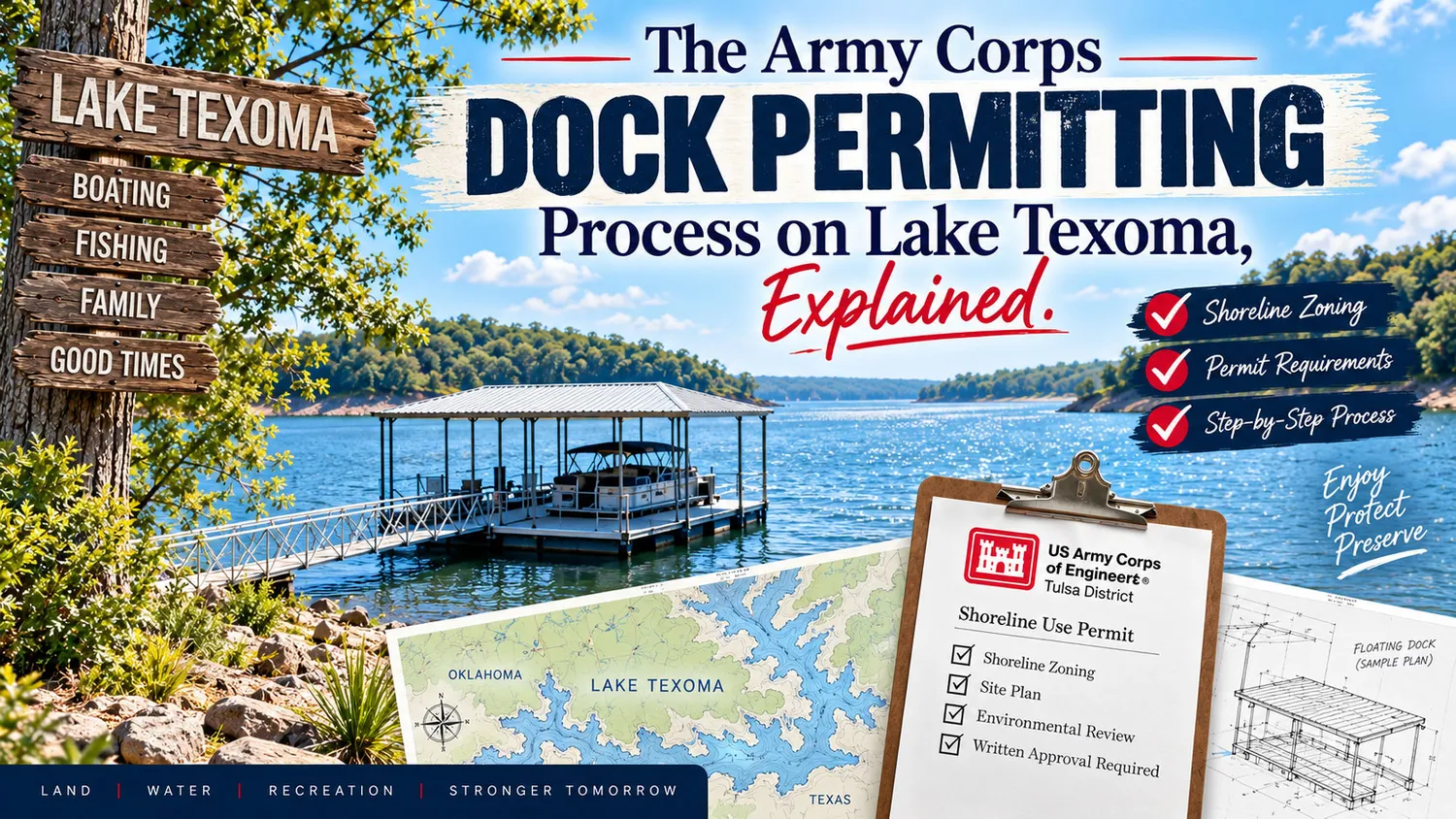
Getting a dock permit at Lake Texoma starts with the U.S. Army Corps of Engineers (USACE) Tulsa District, not a city or county office, because most of the lake's shoreline sits on federal land held under flowage easements. To build or maintain a private boat dock, an owner must submit a Shoreline Use Permit application (USACE Form SWT 1133) to the Lake Texoma Project Office, along with engineer-certified plans, proof of legal access to the shoreline, a site map, and boat registration documents, then wait for the Corps to review the request against the current Lake Texoma Shoreline Management Plan (SMP) before any construction begins.

Lake Texoma was created when the Corps completed Denison Dam on the Red River, and the reservoir itself is a federal flood-control project. Because of that, the government owns or holds easement rights over most of the shoreline around the lake, spanning Grayson County, TX and the Bryan County, OK and Marshall County, OK shorelines on the Oklahoma side. Private lots that back up to the lake typically stop at a property line set back from the water, with the land between that line and the waterline managed by USACE under the Lake Texoma SMP. That distinction matters enormously to buyers: owning lakefront property at Texoma does not automatically include the right to build a dock. It only creates the standing to apply for one.
The Lake Texoma Project Office, based in Denison, Texas, administers the SMP that zones the shoreline into categories such as limited-development, protected or wildlife-management, and prohibited-access areas. Only shoreline zoned for private, limited-development use is eligible for a private floating dock at all. Some coves are zoned for community or commercial marina use instead, and other stretches are closed to private structures entirely to protect wildlife habitat, water intake infrastructure, or public recreation areas. The current SMP took effect in 2021 after a Corps-wide review led to a temporary pause and rewrite of the plan, and permitting has since reopened. Rules, zoning, and even the availability of new permits in a given cove can change again, so a separate article on this site covers the moratorium history in more depth; here, the key point is simply that permitting status is not permanent and should always be confirmed before relying on it.
Before drawing up plans, check the SMP's zoning and cove maps, available through the Tulsa District website or the Lake Texoma Project Office, to confirm the specific shoreline segment is zoned for private floating facilities. Skipping this step is the single most common reason applications stall or get denied.
The formal application is Form SWT 1133, the Shoreline Use Permit application, which covers new floating facilities, vegetation modification, permit renewals, and change-of-ownership transfers. It asks for the applicant's contact information, the property's physical and mailing address, dock dimensions and slip count, boat registration numbers, and, for multi-slip docks, a list of co-owners.
New floating-facility applications generally require two sets of plans and specifications certified by a licensed engineer, proof of legal access or land ownership, a site map or aerial photo showing the proposed dock location, and original or notarized boat registrations. Vegetation-modification requests need a warranty deed and survey plat showing the adjacent private property line. An Electrical Service Compliance Affidavit is required if the dock will have power, since the Corps generally no longer licenses new electric lines crossing government property and instead expects solar or generator alternatives that meet National Electrical Code standards.
Once submitted, the Lake Texoma Project Office reviews the application against the SMP, may request revisions, and can require a site inspection before or after construction. Permits are generally issued within the zoned capacity of each cove, and existing permits must be renewed periodically and formally transferred, typically through a notarized bill of sale, when a dock changes hands along with a property sale.
USACE does not publish one simple, universal fee schedule for Lake Texoma shoreline use permits, and both fees and processing timelines can vary by permit type, cove, and current staffing at the project office. Corps of Engineers lake dock permits have historically involved a modest administrative fee rather than a large development charge, but buyers and current owners should not rely on any specific number quoted in a blog post, real estate listing, or online forum. The only reliable source is a direct call or visit to the Lake Texoma Project Office, since fees, required forms, and whether new permits are even being accepted in a given cove can change with each SMP update.
Because the dock itself often sits on federal land rather than the deeded lot, a listing that mentions a dock is really describing a permit, not a fixture that automatically transfers with the deed. Before writing an offer, buyers should ask the seller or listing agent for a copy of the current, valid Shoreline Use Permit and confirm it is in the seller's name and in good standing, request written confirmation from the Lake Texoma Project Office that the permit is transferable and not expired or under violation, and verify the cove's zoning still allows a private dock under the active SMP rather than an older, superseded plan. A property marketed as having "dock potential" should be treated as unconfirmed until USACE verifies the shoreline segment is zoned for private floating structures and permits are currently being accepted there. These same questions apply whether the property sits in Texas or Oklahoma, since USACE administers the entire reservoir shoreline under one plan regardless of the state line. For a broader look at navigating waterfront purchases in the region, see our guide on how to buy land near Lake Texoma.
Working with a local agent who regularly handles USACE dock transfers can save buyers from an unpleasant surprise after closing. Brian and Jonelle Allen routinely coordinate with sellers and the Lake Texoma Project Office to confirm permit status before a lakefront deal closes, which is one of the most overlooked steps in a Texoma waterfront purchase.


Yes. Because most of the Lake Texoma shoreline is federal land managed under flowage easements, any private boat dock requires a Shoreline Use Permit from the U.S. Army Corps of Engineers Tulsa District before construction begins, regardless of which side of the property line the dock sits on.
Not automatically. A Shoreline Use Permit is issued to a specific permit holder and must be formally transferred, typically through a notarized bill of sale submitted to the Lake Texoma Project Office, so buyers should confirm transfer eligibility before closing rather than assuming the dock conveys with the deed.
Permitting status can change. USACE has paused new shoreline use permits at Lake Texoma in the past while rewriting the Shoreline Management Plan and later reopened applications once the updated plan took effect, so buyers and owners should confirm current status directly with the Lake Texoma Project Office rather than relying on past status.
USACE does not publish a fixed public fee schedule for Lake Texoma shoreline use permits, and costs can vary by permit type and change over time, so the only reliable figure comes directly from the Lake Texoma Project Office at the time of application.
No. The Lake Texoma Shoreline Management Plan zones the shoreline into categories, and only segments zoned for private, limited-development use are eligible for a private floating dock; some coves are reserved for wildlife management, public recreation, or commercial marina use instead.