





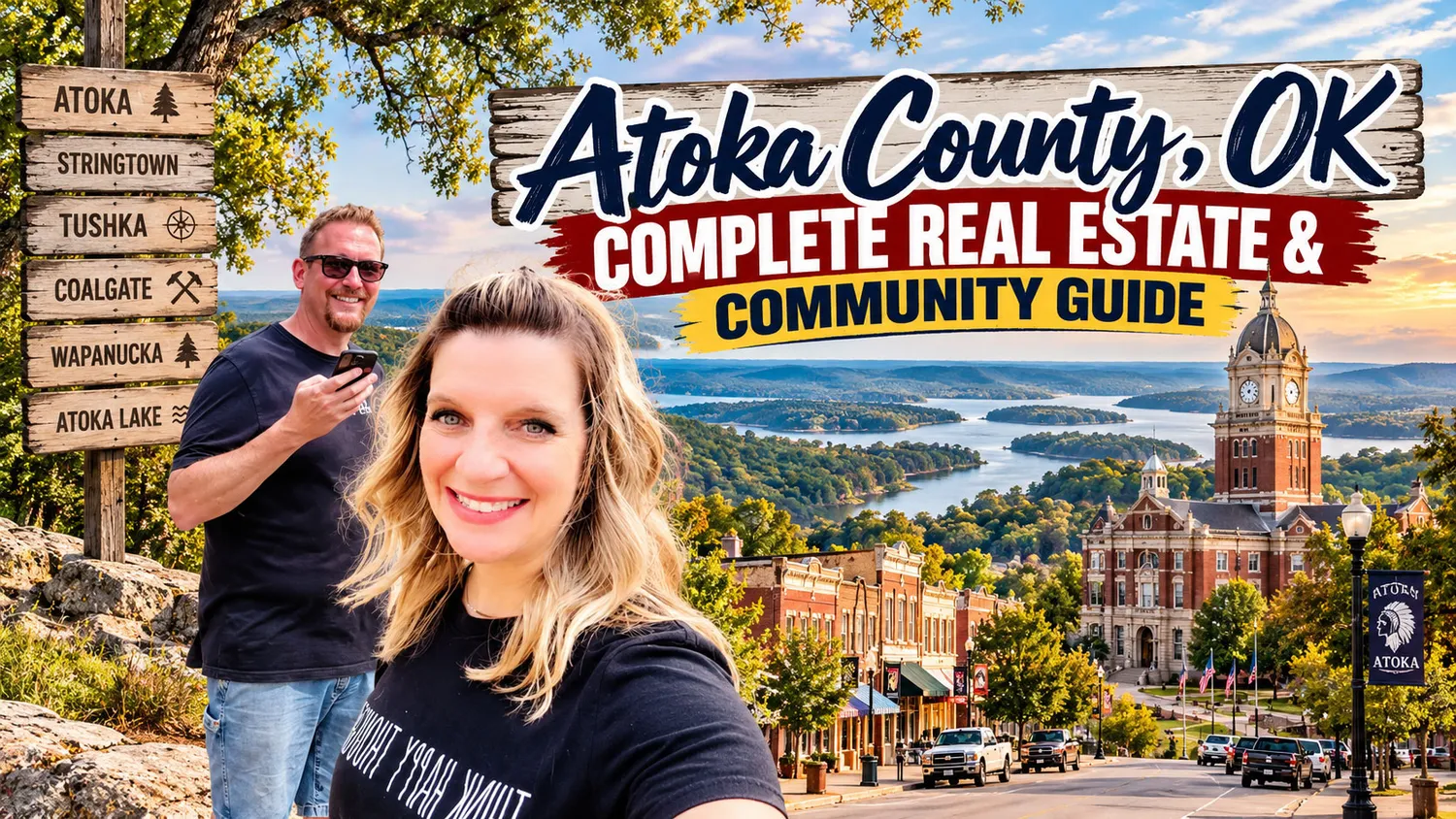
Atoka County, OK is a rural, heavily forested county in southeastern Oklahoma, anchored by the small county seat of Atoka and stretching across nearly 1,000 square miles of creek bottoms, hardwood timber, and rolling hills. For buyers looking at the Lake Texoma region, Atoka County is one of the most affordable places to find acreage, ranch land, and rural homesites — a quiet, land-rich alternative to the busier lake-adjacent towns closer to the water.

Atoka County covers about 990 square miles, of which roughly 976 are land and 14 are water. The terrain shifts noticeably from east to west: the foothills of the Ouachita Mountains rise in the eastern part of the county, while the Sandstone Hills and Coastal Plains regions to the north and west flatten out into more workable land for agriculture and cattle grazing. The county is drained by North Boggy, Clear Boggy, and Muddy Boggy Creeks, and the Atoka Reservoir sits in the northern part of the county, supplying water to Oklahoma City.
The county was formed before Oklahoma statehood out of Choctaw Nation lands and takes its name from a Choctaw chief. Population has fluctuated over the decades — it peaked at nearly 21,000 residents in 1920 during the coal-mining era and settled at roughly 14,600 today. Historically, the local economy leaned on coal mining, limestone quarrying, timber, and farming; cattle ranching later became the leading industry, and it remains central to the county's rural character. The Mack H. Alford Correctional Center, which opened decades ago, is also one of the area's larger employers.
The city of Atoka sits at the crossroads of U.S. Highways 69 and 75, making it the commercial hub for the county. Founded in 1867 by Baptist missionary J.S. Murrow and named for Choctaw leader Captain Atoka, the town grew quickly after the Missouri-Kansas-Texas Railroad arrived in 1872. Today it's home to roughly 3,200 residents, a mix of local businesses, schools, and the kind of small-town amenities that make it a practical base for the surrounding rural county.
Atoka has also picked up some national name recognition in recent years thanks to its most famous native daughter — you can read the full story in our guide to Atoka, Oklahoma: Reba McEntire's Hometown, which covers the town itself in more depth. This article focuses on the broader county surrounding it.
Beyond Atoka, the county includes a handful of small incorporated towns, plus a scattering of unincorporated communities described below. Nearby county seats in the region, like Coalgate, OK just north in Coal County, share a similar coal-mining heritage and rural feel — you can read more in our piece on Coalgate's coal-mining past.
Scattered across Atoka County's back roads are several small unincorporated communities — mostly a church, a cemetery, a cluster of homes, or a former rail siding. Bentley, Lane, Wardville, Daisy, Farris, Chockie, and Limestone Gap are among these places. Detailed histories for most of these small communities are thin, and we won't pretend otherwise here — they're best understood simply as quiet rural crossroads within the county, the kind of places where land is inexpensive and neighbors are few, rather than as attractions in themselves.

Historic downtown Atoka. Photo: Larry D. Moore, CC BY 4.0, via Wikimedia Commons
One community stands apart historically: Boggy Depot. Choctaw and Chickasaw settlers established Boggy Depot in 1837, not long after removal to Indian Territory, and it grew into a significant trading post on the Texas Road and the Butterfield Overland Mail route. A church building there served as a temporary capitol of the Choctaw Nation in 1859, and during the Civil War the town operated as a Confederate supply depot. Boggy Depot's fortunes changed when the Missouri-Kansas-Texas Railway was routed about 12 miles east of town in the early 1870s — passing through what would become Atoka instead. Bypassed by the railroad, Boggy Depot gradually emptied out and became a ghost town.
The site was added to the National Register of Historic Places in 1972 and has long been preserved as a park, with a fishing lake, nature trail, picnic areas, and a historic cemetery where Choctaw Chief Allen Wright is buried. Management of the site has shifted over the years between the State of Oklahoma and the Choctaw Nation; buyers interested in the area's Native American history should confirm current public-access details directly, since ownership and operations have changed more than once. It remains one of the more meaningful historic sites in the entire Texoma region.
Search for Atoka Oklahoma homes for sale and you'll notice the market skews heavily toward acreage rather than subdivisions. Large tracts of pasture, hunting land, and timberland are common, often with a single home, cabin, or manufactured home on-site. Compared to the Texas side of the Texoma region, land in Atoka County generally carries a lower price per acre, and property taxes tend to run lower as well — a big part of the appeal for buyers hunting for rural Oklahoma land near Lake Texoma. Cattle ranches, recreational hunting properties, and small hobby farms make up a large share of listings, alongside modest homes in and around Atoka itself.
For buyers focused on Atoka County OK real estate specifically as an investment in space and privacy rather than proximity to shoreline, this is one of the more budget-friendly corners of the Texoma footprint.
Atoka County doesn't border Lake Texoma directly, but it sits well within striking distance of the broader lake region, and it holds its own water recreation closer to home. McGee Creek Lake and its surrounding state park lie within the county and offer boating, fishing, and camping without the crowds of the main lake — see our guide to McGee Creek State Park: Atoka County's Hidden Lake Getaway for more. For buyers who want to be closer to Texoma's marinas and shoreline, Durant, OK is roughly a half-hour drive north and serves as the region's larger commercial center.
Buyers gravitate toward Atoka County for a few consistent reasons: affordability, acreage, and a genuinely rural lifestyle. It's a fit for people who want a working ranch, a hunting property, or simply room to spread out without paying lakefront prices, while still being within a reasonable drive of Lake Texoma, McGee Creek, and the shops and services in Durant and Atoka. The trade-off is distance from the water and fewer big-town conveniences — a fair exchange, for many buyers, given the land and privacy on offer.
If you're exploring land, a ranch, or a rural homesite anywhere in Atoka County, Brian & Jonelle Allen can help you understand what's currently on the market and what a given property is really worth. Reach out to start your search for Atoka County property today.


Atoka is the county seat of Atoka County, Oklahoma. It sits at the junction of U.S. Highways 69 and 75 and serves as the county's main commercial and government center, with a population of roughly 3,200.
Atoka County is generally included in the broader Lake Texoma region, though it does not border the main lake directly. It lies south of Lake Texoma and contains McGee Creek Lake, a smaller reservoir with its own state park, along with rural land popular with buyers who want proximity to the Texoma area without lakefront prices.
Boggy Depot is a historic unincorporated community founded in 1837 by Choctaw and Chickasaw settlers. A church there briefly served as a temporary capitol of the Choctaw Nation in 1859, and the town later operated as a Confederate supply depot during the Civil War before declining after the railroad bypassed it. The site is on the National Register of Historic Places and is preserved today as a park with a historic cemetery.
Yes. Atoka County's real estate market leans heavily toward acreage, ranch land, and hunting property, and prices per acre are generally lower than comparable land closer to the Texas side of Lake Texoma. This affordability is one of the main draws for buyers searching for rural Oklahoma land near Lake Texoma.
Atoka County includes a few small incorporated towns along with a number of unincorporated communities such as Bentley, Lane, Wardville, Daisy, Farris, Chockie, Limestone Gap, and the historic community of Boggy Depot. Most of these are small rural crossroads rather than commercial centers, reflecting the county's overall low-density, land-focused character.


Guides & Resources
For Buyers
Buying a Home in TexomaFirst-Time Home Buyer ProgramsNative American Homebuyer ProgramsThe Closing ProcessNew Construction GuideBuying Land & AcreageLenders & Local Pros