


$774,990
Active
4
Beds
4
Baths
3596
Sqft
0.1653
Acres
2624 Cone Flower St, Mckinney, TX 75071
MLS#: 21185430



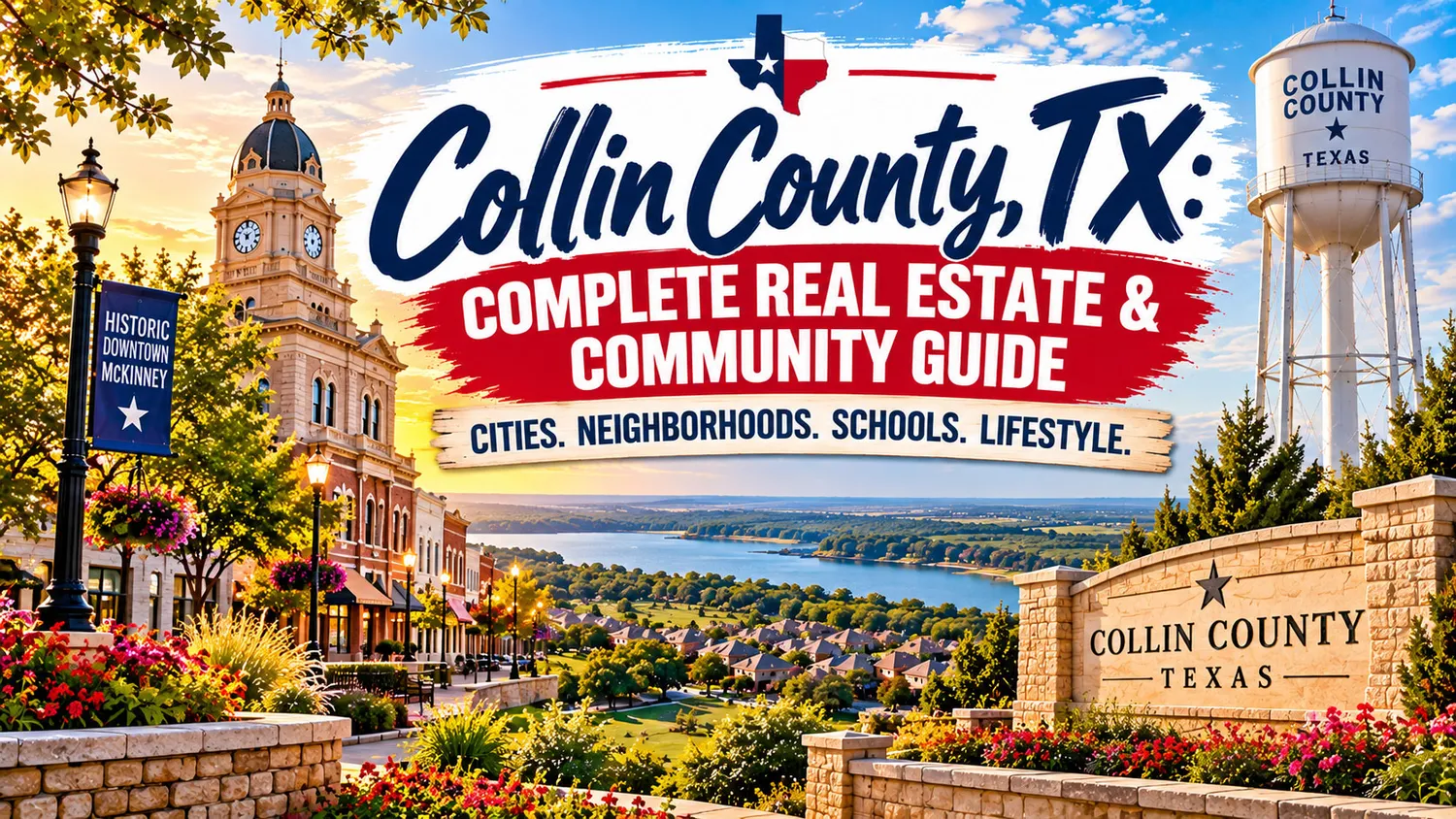
Collin County, TX real estate spans two very different worlds: a booming suburban core anchored by Plano, Frisco, McKinney, and Allen, and a quieter, more rural northern half where small towns and unincorporated crossroads communities sit closer to farmland than freeways. If you're searching for Collin County homes for sale, the county seat of McKinney and its neighbors have made this one of the fastest-growing counties in the entire United States — but the northern edge of the county, roughly 45 minutes to an hour from Lake Texoma, still offers acreage, small-town pace, and prices well below the suburban core. That contrast is exactly why Brian & Jonelle Allen focus much of their Collin County, TX coverage on its northern reaches — the part of the county that functions as an affordable, lake-adjacent alternative to the DFW rush.

Collin County has grown from roughly 491,000 residents in 2000 to well over a million today, making it Texas's sixth-most populous county and one of the fastest-growing counties in the nation over the past two decades. That growth has been driven almost entirely by its southern and central cities: Plano is the county's largest city and a major corporate hub, Frisco has become a nationally known destination for sports venues and new master-planned communities, McKinney (the county seat) regularly lands on "best places to live" lists, and Allen rounds out the group with strong schools and steady new construction. Together, these cities have pushed median home prices, lot sizes, and commute-driven demand in directions that price out many buyers who want more land or a slower pace of life without leaving the county entirely.
North and east of McKinney, Collin County looks and feels different. Farmersville, TX, about 18 miles east of McKinney, was known in the 1930s as the "Onion Capital of North Texas" and still carries that small-town identity today, with roughly 4,000-plus residents, a walkable historic downtown, and Lake Lavon touching its western edge. Sachse, TX, on the county's southeastern edge, offers another lower-key alternative near Lake Lavon, while Trenton, TX sits farther north along US-69, straddling the Collin-Fannin County line and putting buyers noticeably closer to Lake Texoma country.
Scattered between and around these towns are several unincorporated communities that rarely show up in mainstream real estate coverage but are part of the fabric of rural Collin County. Copeville, on Highway 78 southwest of Farmersville, traces back to an 1850s settlement and once supplied bois d'arc timber for Dallas street paving before settling into a quiet population of around 100. Westminster, northeast of McKinney, grew up around a namesake Methodist college in the 1890s, incorporated and later disincorporated in 2005, and today is best known locally as a stop for motorcyclists. Seis Lagos, near Lucas, is a gated, six-lake community developed starting in the 1970s by the family behind the real-life Southfork Ranch, with around 1,100-1,450 residents split between Wylie and Lovejoy school districts. Altoga, Chambersville, and Culleoka are smaller still — old farming and mill crossroads northeast and east of McKinney whose populations peaked generations ago and now number in the dozens to low hundreds, kept alive mostly by nearby residential growth rather than any commercial center. A community sometimes labeled Climax appears on older county maps in this same rural stretch, though documented history is sparse enough that it's best described honestly as a small, largely undeveloped crossroads rather than a place with much recorded past.

The practical difference for buyers is stark. In Plano, Frisco, McKinney, and Allen, new subdivisions, corporate relocations, and constrained land supply keep competition and prices high, and lot sizes shrink as builders maximize density. In Farmersville, Trenton, and the unincorporated communities around them, buyers more commonly find larger lots, acreage tracts, and older homes with room to add outbuildings, workshops, or horses — all at price points that can be substantially lower per square foot than the suburban core just twenty or thirty miles south. Property tax rates and HOA prevalence also tend to ease the farther north you go, though buyers should still expect to work with a well and septic system in many of the more rural pockets rather than municipal utilities.
Northern Collin County's other advantage is geography. Farmersville and Trenton sit within a reasonable weekend-drive radius of Lake Texoma, with towns like Sherman, TX and the lake's southern shoreline roughly 30-45 minutes further north depending on the exact starting point. For buyers who want a primary residence with acreage but also want quick access to boating, fishing, and lakefront recreation, northern Collin County offers a middle ground that pure DFW suburbs simply can't match — you keep a shorter commute into the metroplex on U.S. 75 or U.S. 380 while gaining much easier lake access than a Plano or Frisco address would allow.
Many of the buyers Brian & Jonelle work with are relocating directly out of the county's own booming core. As we've covered in Moving from McKinney or Frisco to Lake Texoma, families and retirees who already love Collin County's schools, job market, and amenities are increasingly trading a crowded suburban lot for more land and a lake-friendly lifestyle without leaving the region they know. Others are simply looking for the kind of small, low-profile places detailed in Beyond the City Limits: Lake Texoma's Secret TX & OK Communities — quiet, under-the-radar spots that offer character and privacy the master-planned subdivisions can't replicate.
Whether you're evaluating a move within the booming Collin County suburbs or looking specifically at its rural northern communities — Farmersville, Trenton, Copeville, Westminster, Seis Lagos, or the smaller crossroads around them — Brian & Jonelle Allen know this stretch of the county and its connection to Lake Texoma firsthand. Reach out today to talk through what's available in northern Collin County and how it fits your search for a home, acreage, or a lake-adjacent lifestyle.


Yes, though it depends heavily on where in the county you look. The southern and central cities (Plano, Frisco, McKinney, Allen) are among the fastest-growing, highest-demand markets in the DFW metroplex, with correspondingly higher prices. The northern part of the county, including Farmersville and Trenton, offers more affordable acreage and a slower pace while still being within Collin County.
Towns like Farmersville and Trenton in northern Collin County are typically within a 30-60 minute drive of Lake Texoma's southern shoreline, depending on the exact starting point and destination marina, making them a realistic option for buyers who want both a Collin County address and reasonably close lake access.
Collin County includes several small unincorporated communities such as Copeville, Westminster, Seis Lagos, Altoga, Chambersville, Culleoka, and a sparsely documented spot sometimes called Climax. Most are former farming or mill crossroads with populations ranging from a few dozen to a few hundred, and some, like Seis Lagos, have been redeveloped into modern gated communities.
Many buyers are drawn by larger lot sizes, lower price points per square foot, less HOA density, and easier access to lake recreation, while still staying reasonably close to DFW job centers and the schools and amenities they already know from Collin County's suburban core.
Not in the traditional sense — these are unincorporated communities without their own city government, school district, or dedicated commercial center, so homes there are typically marketed under the nearest larger town (such as Farmersville or McKinney) and often sit on acreage rather than in platted subdivisions.
Guides & Resources
For Buyers
Buying a Home in TexomaFirst-Time Home Buyer ProgramsNative American Homebuyer ProgramsThe Closing ProcessNew Construction GuideBuying Land & AcreageLenders & Local Pros