





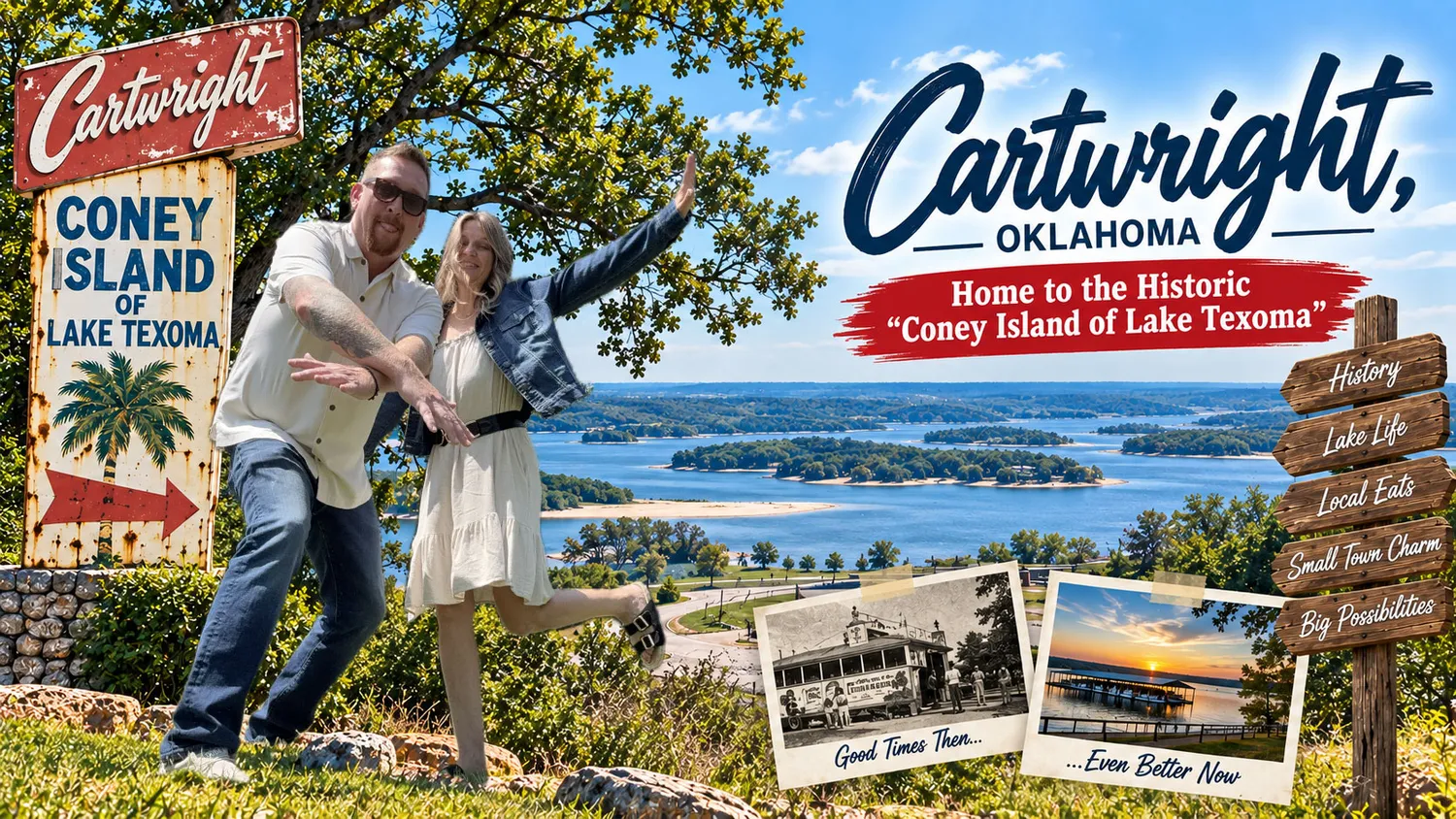
Cartwright, Oklahoma is an unincorporated community of fewer than 500 residents tucked against the Oklahoma shoreline of Lake Texoma in Bryan County — and in the late 1940s, it was home to one of the wildest tourist attractions in the Southwest: a lakeside amusement park locals nicknamed the "Coney Island of Lake Texoma." Today it's easy to drive right through Cartwright without ever knowing that a Ferris wheel, a Mississippi riverboat, and 225,000 summer visitors once passed through this same stretch of shoreline. Here's the real story of how it happened, what's left of it today, and what it means if you're thinking about buying nearby.
Cartwright didn't exist before Lake Texoma did. The community grew up around 1940 out of worker housing built during construction of Denison Dam, and its post office officially opened on April 25, 1940 — making it one of the newer communities in Bryan County. It was later named for U.S. Congressman Wilburn Cartwright, who represented the district and championed the dam project in Washington. When engineers closed the floodgates on Denison Dam in February 1944, Lake Texoma's waters began spreading out behind what was then the world's largest rolled earth-filled dam, and almost nobody involved in taming the Red River realized they were also building a recreational magnet that would draw hundreds of thousands of visitors within just a few summers. Cartwright's location — close to Durant and sitting right on the lake's new Oklahoma shoreline — gave the tiny community an unexpected second act almost immediately.
By 1947, the Army Corps of Engineers began taking bids for concession sites on the newly formed lake, and one of the most desirable stretches of shoreline was a spot just off the Oklahoma side of Denison Dam known as Burns Run. The winning bid went to Carl H. Browall, a businessman from Ada, Oklahoma, who got the green light to develop the site in April 1947. Racing to be ready for Memorial Day weekend, Browall's crews bulldozed and graveled roads, cleared a beach, made the shoreline safe for swimming, and hauled in portable concession stands. The gamble paid off almost instantly: by late July of that first summer, an estimated 225,000 people had already visited Burns Run.
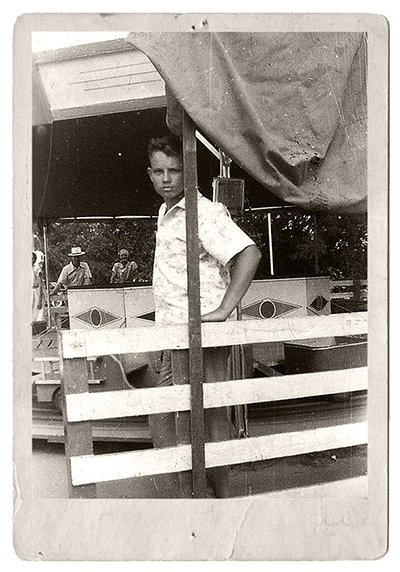
Development continued through the off-season, and in July 1948, veteran carnival operator Alvin Bain set up permanent amusement rides a few hundred yards north of the beach — a Ferris wheel, a tilt-a-whirl, a merry-go-round, and a handful of kiddie rides including Kiddie Kars, an airplane ride, and a small train. By the 1949 summer season, Bain's rides were a fixture and people up and down the region were calling Burns Run the "Coney Island of Lake Texoma." The park kept growing from there: truckloads of white sand doubled the size of the beach, ninety picnic tables went in between the beach and the midway, and a penny arcade, an eighteen-hole miniature golf course, and an outdoor bowling alley opened to keep visitors entertained between swims. Twenty-one resort cabins gave vacationers a reason to stay the whole weekend instead of just the day.
Wayne Bacon, a Cartwright teenager who worked the rides at Burns Run in the early 1950s, remembered riding his bicycle about a mile to and from the park all summer to run the Ferris wheel and the kiddie rides. The park opened at seven each evening, but on the Fourth of July it opened at three in the afternoon and didn't close until midnight — "shoulder to shoulder people," he recalled, and easily the busiest day of the year.
Burns Run's promoters didn't stop at rides and a beach. As development along the shore accelerated, Frank and Henry Wilburn — who owned a market in Denison — and a third Wilburn brother, Glenn, from Dallas, saw an opportunity to bring a genuine Mississippi-style riverboat to Lake Texoma. They found the Wanderer, a wooden, 72-foot stern-wheeler based in Greenville, Mississippi, and had her towed down the Mississippi and up the Red River on a difficult 42-day trip. At the dam, workmen hauled the boat out of the river and trucked her around to a launching spot near Grandpappy Point. With a capacity of two hundred passengers, she would have been the largest passenger boat operating on inland water in the Southwest.
She never got the chance. In the predawn hours of February 29, 1949, fire broke out aboard the Wanderer while she was tied up at Burns Run awaiting her public debut. The Wilburn brothers rushed toward the burning boat with fire extinguishers, but as they closed to within fifty feet, an explosion sent the paddle wheeler to the bottom of the lake, thirty to thirty-five feet down, and the brothers' plans died with her before a single paying passenger ever boarded.
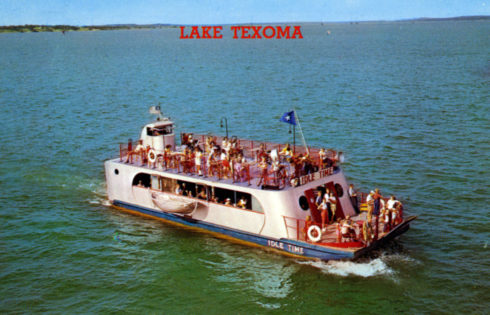
The loss of the Wanderer didn't kill the idea of lake cruises out of Burns Run. In 1951, G. E. Hibarger launched a second excursion boat, the Idle Time, a 48-foot iron-and-steel double-decker he'd purchased at the Lake of the Ozarks and moved to Texoma. The Idle Time ran regularly scheduled cruises out of Burns Run with stops at Willow Springs Marina and Lake Texoma Lodge, charging about a dollar a ride, and was in high demand for dinner-dance cruises and chamber-of-commerce charters in the off-season.
Much of the 1950s brought a brutal, prolonged drought to Texas and southern Oklahoma. Beginning in 1950, rainfall ran roughly forty percent below normal for years, and Lake Texoma became an even bigger draw for people escaping the summer heat. The dry spell bottomed out in 1956, one of the driest years in Texas history. Then, in a dramatic reversal, the seven-year drought broke completely in the spring of 1957.
The break came fast and hard. On May 18, just two months after the lake had fallen to an all-time low, heavy rains over the watershed sent the water level rocketing upward. Five days later, history was made as water began pouring over the spillway for the first time since the dam's completion, and the trickle quickly turned into a torrent. By June 6, Lake Texoma crested at 643.18 feet — more than twenty-five feet above normal pool elevation. The flood devastated the lake's major resorts, and Burns Run, with all its rides and attractions, was demolished.
Operators tried to hang on. The arcade reopened for a time, but Burns Run never recovered its Coney Island atmosphere. Edwin Best, who by then owned the carnival rides, sold off his equipment and retired in 1958. The eroded beach was never rebuilt at its old scale. The Idle Time survived the flood but eventually fell victim to changing times — as private marinas and personally owned boats and yachts exploded in popularity through the 1960s, the aging excursion boat fell into disrepair, and by the mid-1970s she was cut up for scrap metal, closing out one of the more colorful chapters in Lake Texoma's history.
Today's Cartwright is quiet by comparison to its Coney Island heyday — a small, entirely rural residential community of roughly 490 people best known as an access point to Lake Texoma rather than a tourist strip. Burns Run West Marina and campground still operate near the original resort site and remain a popular spot for boat access and fishing piers, and East Burns Run offers additional camping and day-use areas managed by the Army Corps of Engineers. Most homes in the Cartwright area are lake cabins, weekend places, and a modest number of full-time residences, with larger inventory and everyday services concentrated a short drive away in Durant.
For buyers who want to be close to the water without paying Preston Harbor-level prices, yes — unincorporated Bryan County communities like Cartwright tend to offer more affordable lake access than the higher-profile developments closer to Denison. The trade-off is fewer in-town amenities, so most Cartwright-area buyers treat Durant as their closest full-service town for groceries, healthcare, and schools.
Cartwright isn't the only small community in this pocket of Bryan County worth a look. Just up the shoreline, Colbert offers its own mix of lake-adjacent and rural properties with easy access to both Durant and the Texas side of the lake, while Platter, a tiny unincorporated community a few miles northeast of Cartwright, appeals to buyers looking for larger acreage tracts and a genuinely rural setting still within a short drive of the water. Because national portals rarely build out content around communities this small, buyers who do their homework here can often find value that's harder to come by in the more heavily marketed parts of the lake.
Whether you want a weekend cabin near the water, a full-time home with easy access to Durant, or acreage further out toward Colbert or Platter, we can help you compare what's actually available in this part of Bryan County. Browse current Cartwright listings, Colbert listings, or Platter listings, start with a broader search of Lake Texoma listings, or call (580) 217-7435 to talk through what fits your budget and plans.


