






New - 1 Day Ago





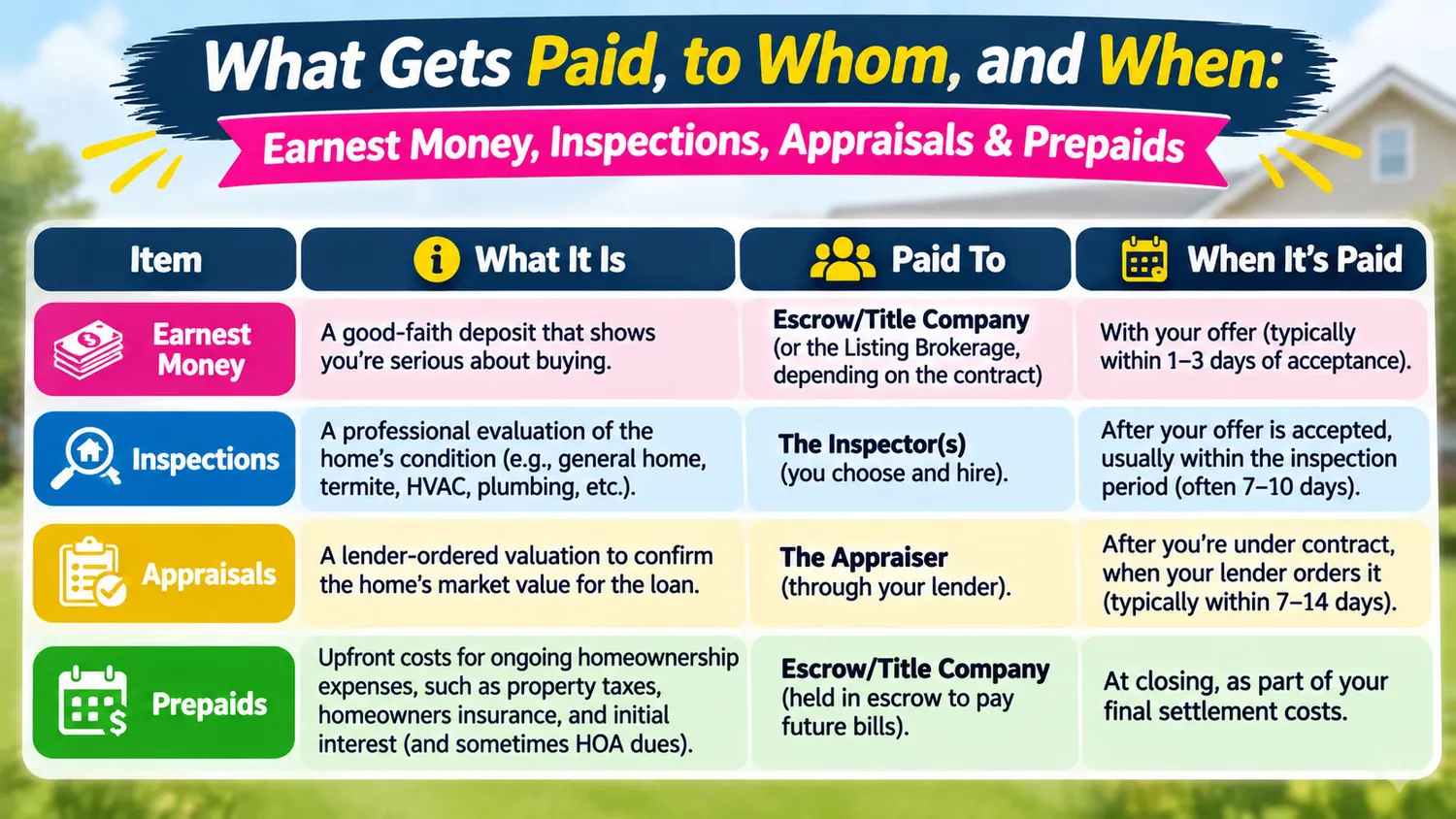
Buying a home isn't one big payment on closing day — it's a string of smaller ones that start the moment your offer gets accepted. Earnest money, an option fee or inspection-period arrangement, inspection costs, the appraisal fee, and a bucket of "prepaids" at the closing table all show up at different times, go to different people, and aren't all optional. Here's the actual order of operations, so nothing catches you off guard.
Most buyers think of "closing costs" as one lump sum due at the end. In practice, you'll write several smaller checks (or send wires) well before you ever sit down at the closing table. Roughly in order:
We cover earnest money in detail in Part 4 of this series and inspections in Part 5 — this post focuses on the dollar figures, who actually gets paid, and the one category buyers almost never budget for: prepaids.
Earnest money runs roughly 1%–2% of the purchase price in our market and goes to a neutral title or escrow company, not the seller — it's credited back to you at closing. In Texas, a separate, smaller option fee (often a few hundred dollars) goes directly to the seller during the option period — it buys you the right to walk away for any reason during that window, and it's typically non-refundable even if you cancel. Oklahoma contracts generally handle this through an inspection period instead of a separate option fee — ask your agent which structure applies to your contract. Full breakdown, including when you get earnest money back, in Part 4.
Unlike earnest money, inspection fees don't route through escrow — you pay the inspector directly, usually by card or check at the time of the inspection, and the money doesn't come back regardless of what they find. In our market, budget roughly:
Is it optional? Legally, in most cases, yes — nothing forces you to inspect a home. Practically, no: skipping it to save a few hundred dollars on a six-figure purchase is one of the more common regrets we hear about after the fact. For what an inspection actually covers and why your agent hands this off to licensed pros instead of weighing in ourselves, see Part 5.
If you're using a mortgage, your lender orders an appraisal to confirm the home is worth what you're paying — and you pay for it, typically $450–$650 for a conventional single-family appraisal in our market, more for acreage, waterfront, or unusual properties, and sometimes slightly more for FHA or VA appraisals given their added requirements. Most lenders charge this up front, by card, when they order it, rather than waiting to fold it into your closing costs — ask yours which way they handle it so it doesn't surprise you.
Is it optional? Only if you're paying cash. A cash buyer can still order an appraisal for their own peace of mind, but nothing requires it. A financed buyer doesn't get a choice — the lender won't fund the loan without one. What happens when the number that comes back is lower than your contract price is its own topic, covered in Part 6.
This is the one that catches people off guard, because it isn't a fee for a service — it's you funding accounts you'll need anyway, just earlier than you expected. If your loan has an escrow account (most do), your lender collects money at closing to prefund it, on top of your down payment and closing costs:
Is it optional? Mostly no. If your lender requires an escrow account — standard on FHA and VA loans, and common on conventional loans with less than 20% down — you don't get to skip this. Some conventional borrowers with strong down payments can opt out of escrow and pay their own taxes and insurance directly instead, usually for a small fee or rate adjustment; ask your lender if that's available to you, and run the math before assuming it's the better choice. Prepaid interest isn't optional at all — it's simply how mortgage interest timing works.
| Payment | Paid To | When | Typical Amount | Optional? |
|---|---|---|---|---|
| Earnest money | Title/escrow company | Within days of contract | 1%–2% of price | No — standard practice; refundable under contingencies |
| Option fee (TX) | Seller, directly | Within days of contract | A few hundred dollars | Effectively no in Texas; buys your right to walk away |
| Home inspection | Inspector, directly | At time of inspection | $350–$550+ | Legally yes, practically no |
| Well/septic/termite | Specialist, directly | At time of inspection | $75–$350 each | Depends on property type/loan |
| Appraisal fee | Lender/appraiser | When lender orders it | $450–$650+ | No, if financing; not needed for cash |
| Homeowners insurance (prepaid) | Insurance company, via lender | At closing | Full first year + 2–3 mo. cushion | No, if escrowed |
| Property tax reserve | Escrow account | At closing | Several months, varies by timing | No, if escrowed |
| Prepaid daily interest | Lender | At closing | Days remaining in that month | No — not negotiable |
Add earnest money, inspection costs, the appraisal fee, and your down payment and closing costs (including prepaids) together, and you get your real cash-to-close — the number that actually determines whether you can close on a given house. For the full closing-costs breakdown beyond prepaids, see Part 7; for a complete walkthrough of the process end to end, our Closing Process guide covers what happens at the table itself.
Every lender, title company, and county does the math slightly differently — this is general education, not a substitute for your actual Loan Estimate and Closing Disclosure. If you want help figuring out what your specific numbers will look like before you write an offer, that's exactly the kind of question we're happy to run through with you.


Guides & Resources
For Buyers
Buying a Home in TexomaFirst-Time Home Buyer ProgramsNative American Homebuyer ProgramsThe Closing ProcessNew Construction GuideBuying Land & AcreageLenders & Local Pros